Simplify Your Finances: The Tax Deduction Tracker Template
Tax season often brings a distinct sense of dread, usually stemming from the chaotic scramble to locate receipts and categorize expenses from months prior. As a creative professional or small business owner, your focus is naturally on growth and creation, not administrative tedium. The Tax Deduction Tracker Canva Template 1 is designed specifically to bridge that gap between creative workflow and necessary financial housekeeping. It is not just a spreadsheet; it is a modern typography asset that transforms record-keeping into a streamlined, visually intuitive process.
At first glance, the template strikes a perfect balance between functionality and aesthetic restraint. It avoids the cluttered, dense look of traditional accounting software exports. Instead, it utilizes a clean, sans serif font that prioritizes legibility above all else. This typeface choice is deliberate; in the context of financial data, readability is paramount. You need to be able to scan columns quickly without eye strain. The visual personality of this tracker is professional yet approachable—think of it as a well-organized studio manager rather than a stern accountant. The layout breathes, using whitespace effectively to separate distinct data points, which is a core principle of effective editorial design.
Visual Hierarchy and Functional Design
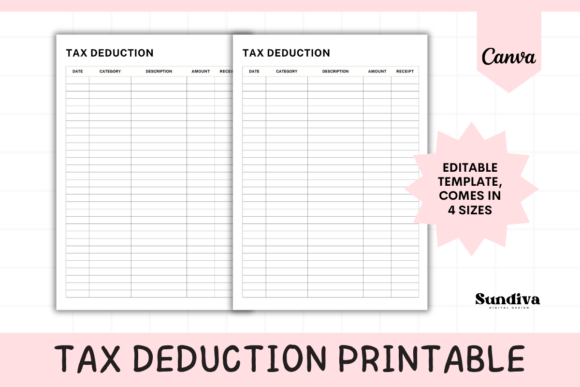
The strength of the Tax Deduction Tracker Canva Template 1 lies in its structural logic. It organizes critical information into five distinct columns: Date, Category, Description, Amount, and Receipt. This structure acts as a visual grid that guides the eye naturally from left to right. By utilizing a premium font system that likely pairs a bold weight for headers with a regular weight for data entry, the template establishes a clear visual hierarchy. This ensures that the category headers do not compete with the numerical data beneath them.
For those concerned with brand identity, even your internal financial documents should feel consistent. Because this is a Canva-based design asset, you have the flexibility to adjust the color palette to match your personal or business brand. However, the default style is already optimized for high contrast and legibility. It is a creative font application that understands its environment; it does not need to be flashy. In web design or packaging design, we often use expressive display fonts to grab attention. Here, the typography serves a utilitarian purpose, acting as the silent workhorse that organizes your fiscal life. This is the hallmark of good modern typography—it serves the content, not the other way around.
Practical Applications for the Modern Creative
While the primary function is tax preparation, the utility of this tracker extends into broader budgeting and project management. For the entrepreneur or marketer, tracking expenses is not a once-a-year activity; it is a monthly discipline. The inclusion of the "Receipt" column is particularly valuable. In a digital-first world, this column can serve as a hyperlinked reference to a digital folder or a cloud storage location, effectively turning your tracker into a lightweight database.
Consider the workflow of a content creator or blogger. You might purchase stock photos, props for a shoot, or software subscriptions. Logging these immediately into the Tax Deduction Tracker Canva Template 1 prevents the "shoebox syndrome" where receipts pile up unsorted. The serif font and sans serif font pairings often found in these templates are chosen to handle dense information without looking messy. It is a tool that encourages consistent habit formation. By making the entry form visually pleasing, you lower the psychological barrier to actually doing the work.
Integration and Customization in Canva
One of the most significant advantages of this product is the delivery method. Receiving a PDF with a link to a Canva template is the modern standard for digital products. It allows for infinite customization without the need for complex desktop publishing software. Whether you prefer a US Letter size for your desk printer or an A5 size for a planner insert, the template scales gracefully. This versatility makes it a robust piece of design assets for your library.
When customizing, pay attention to the font pairing. If you choose to alter the text, ensure that your chosen display font or script font does not compromise the numerical clarity. A common mistake in DIY design is choosing a decorative font for data tables. My advice: keep the headers stylish if you must, but stick to a monospaced or highly legible sans serif font for the numbers and descriptions. The Tax Deduction Tracker Canva Template 1 already provides a solid baseline for this. It respects the rules of commercial font usage where legibility dictates style.
Ultimately, this template is more than just a grid; it is a strategic tool for small business owners and crafters who want to take control of their finances without sacrificing their aesthetic standards. It proves that utility and design are not mutually exclusive. By integrating this tracker into your daily routine, you prepare for tax season with the same confidence you bring to your creative projects. It is a practical application of modern typography that saves time, reduces stress, and keeps your business running smoothly.